
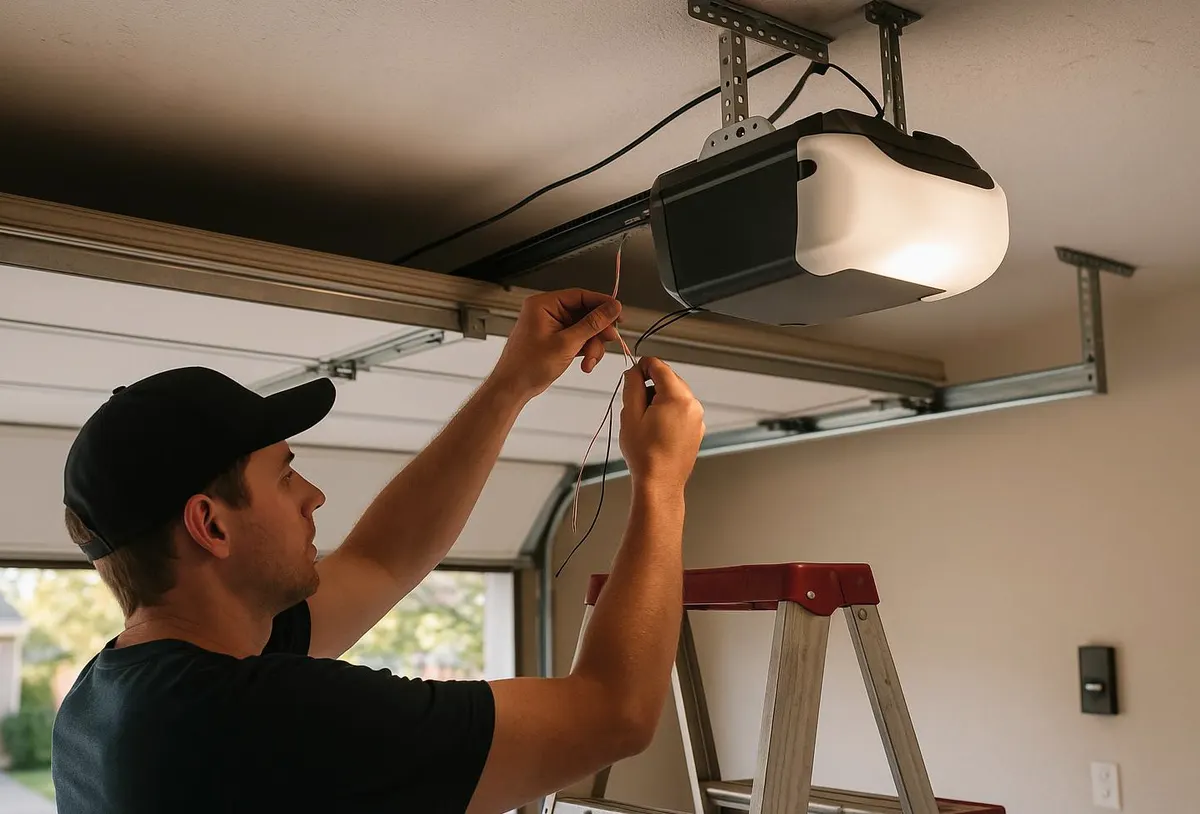
Rule of thumb: if the door won't open, the problem is almost always power, a safety sensor, or a spring — in that order of likelihood. The exceptions are older torsion systems where a cable has jumped the drum, and openers nearing the end of their service life where the motor or circuit board has simply worn out. Those take more than a quick check to confirm, which is exactly why a technician works through the easy stuff first.
What You're Seeing Matters
Before any tools come out, the symptom tells us where to start:
- Nothing happens at all — no motor sound, no lights on the opener. This points to power.
- The opener light blinks but the door doesn't move, often with a specific blink pattern. This usually points to the safety sensors.
- The motor runs, you hear it working, but the door doesn't budge or only shudders. This points to the drive mechanism or, on older units, a worn gear.
- The door opens partway and reverses or stops. This can be sensors, track obstruction, or a spring that's lost tension.
- The door won't move even when you pull the manual release and lift by hand. This is almost always a broken spring, and it's the one that needs the most caution.
Match your symptom to the list below and you'll know roughly where the issue sits before anyone shows up.
1. Power to the Opener
The first check is always the simplest: is the opener actually getting electricity? A tripped breaker, a GFCI outlet that's popped, or a loose plug in the ceiling outlet will stop everything cold. Garages that share a circuit with outdoor outlets are more prone to nuisance trips, especially after a rainy stretch when moisture gets into an exterior receptacle. The fix here is just resetting the breaker or outlet and confirming the opener powers back up — no parts involved.
2. The Safety Sensors (Photo Eyes)
Every opener built in the last few decades has two small sensors low on each side of the track that shoot an infrared beam across the doorway. If that beam is blocked, misaligned, or dirty, the opener will refuse to close the door and can also refuse to open it or will reverse mid-cycle. This is one of the most common calls we get, and it's often weather-related: dry-season dust and wildfire smoke residue settle on the sensor lenses, and a stray cobweb or a bike leaned against the wall can block the beam entirely. The fix is cleaning both lenses with a soft cloth and realigning them until the indicator lights on both units go solid instead of blinking.
3. The Manual Disconnect
If the red release cord hanging from the trolley has been pulled — sometimes by a curious kid, sometimes during a power outage when someone opened the door by hand — the opener is mechanically disconnected from the door even though it still runs fine. The telltale sign is the opener motor running normally while the door itself doesn't move. Reconnecting it just means pulling the cord again (or pushing the lever, depending on the model) until it clicks back into the carriage.
4. Remote or Keypad Issues
If the wall-mounted button opens the door but the remote or keypad doesn't, the problem is almost never the opener itself. Dead batteries, a remote that's lost its programming after a power blip, or a keypad exposed to a wet winter are the usual culprits. This is a quick fix: new batteries, a reprogram, or a keypad with corroded contacts replaced.
5. Broken or Worn Springs
If the opener runs but strains, makes a louder motor noise than usual, or the door won't move even when disconnected and lifted by hand, suspect the springs. A torsion spring that's snapped will often leave a visible gap in the coil above the door, and a broken extension spring (the kind that stretches along the upper tracks) will look collapsed or have a cable hanging loose. Springs carry serious tension and should only be handled by someone trained to do it — this is the point where a technician takes over entirely rather than handing back a quick fix. Replacement involves matching the spring to the door's weight and cycle rating, and it's worth doing both springs at once if the door is several years old, since the second one is usually close behind.
6. Cables, Rollers, and Track Alignment
A cable that's slipped off its drum, a bent track, or rollers that have worn down or rusted (common on coastal properties where salt air accelerates corrosion on exposed hardware) can bind the door enough that it won't travel, even with good springs and a working opener. A technician checks the tracks for gaps, dents, or anything that's come loose, and resets or replaces hardware as needed.
7. The Opener's Gears, Belt, or Logic Board
Last on the list because it's the least common cause: if everything above checks out and the door still won't open, the opener's internal gear (on chain or screw drives), the belt (on belt drives), or the circuit board itself may have failed. Stripped plastic gears are a known wear point on openers that are eight to ten years old or more. At this point the conversation shifts from repair to a cost comparison, since a new logic board on an aging unit can approach the cost of a new opener.
When to Call Oxnard Garage Door
If you've checked the breaker, wiped down the sensors, and confirmed the manual release is engaged and the door still won't open — or if you can see a gap in a spring coil — it's time to call. We offer same-day service for exactly these situations, and our Spring Replacement and Garage Door Opener Repair & Installation services cover the two most common failure points. We'll run through this same checklist on-site, explain what's actually broken, and give you straight options before any work starts.
Door stuck shut in Oxnard, Ventura, Camarillo, or anywhere in Ventura County? Call Oxnard Garage Door today and we'll get it moving again.