
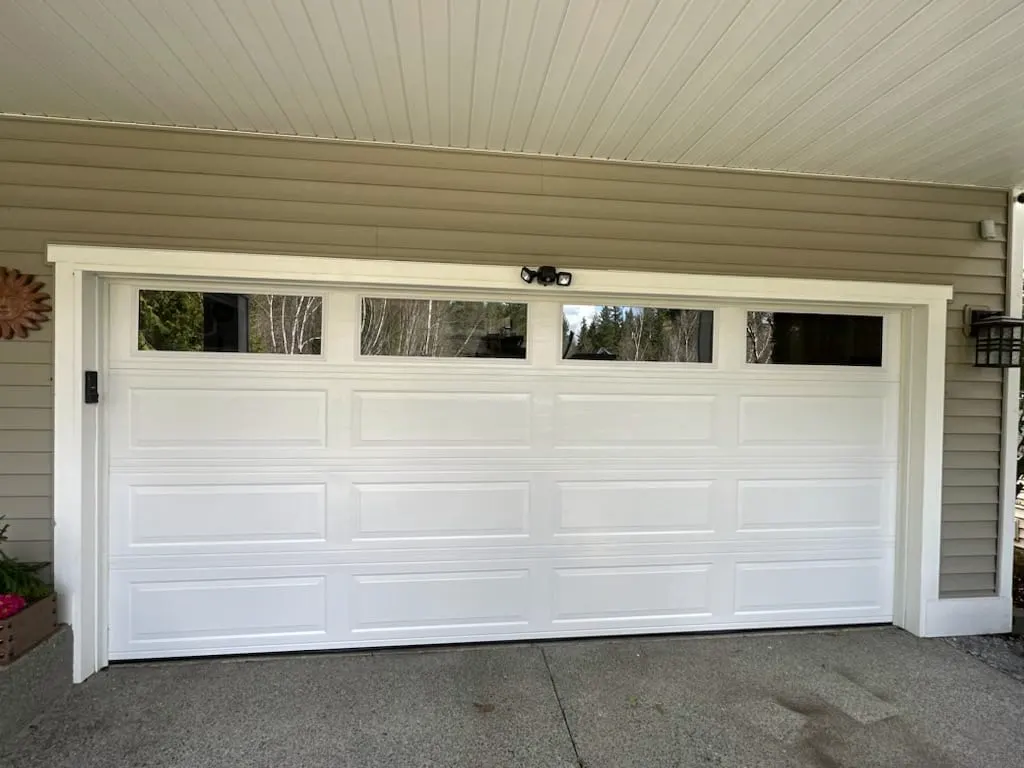
Every winter you don't settle this, you're either overpaying for insulation you don't need or living with a garage that's 15 degrees colder than the rest of the house during a cold snap. Multiply that by another season of someone adjusting the thermostat and grumbling about the garage door, and it's worth just answering the question properly instead of guessing.
What R-value actually measures
R-value is a number that tells you how well a material resists heat flow. Higher R-value means heat moves through it more slowly, in either direction. On a garage door, that number refers to the door panel itself: a single layer of steel has almost no R-value, while doors with foam injected between two steel layers can hit R-12 to R-18 or higher, depending on thickness and construction.
Here's the part that gets argued about: R-value doesn't make a room "warm" or "cool." It slows down how fast temperature changes. A garage with an insulated door won't heat or cool itself, but it will hold whatever temperature it's at longer, and it won't swing as wildly when the outside temperature does.
Who actually benefits
- Attached garages with a shared wall to living space. If your garage sits right next to a bedroom, laundry room, or the kids' playroom, an uninsulated door lets outside temperature swings transfer through that shared wall faster than you'd think. This matters more on hot inland days in Camarillo, Moorpark, or Simi Valley than it does right on the coast.
- Garages used as workshops, home gyms, or offices. If you spend real time out there, an insulated door is the difference between a usable space and one you avoid for half the year.
- Anyone bothered by noise. Insulated doors are almost always thicker and heavier, which deadens road noise and the door's own operating racket. If a bedroom is near the garage, this alone can be worth it.
- Coastal homes dealing with condensation. Salt air and the marine layer create temperature and humidity swings that can cause moisture to form on an uninsulated steel door. Insulated doors with a thermal break resist this better, which means less surface rust over time.
Who's paying for nothing
- Detached garages used only for storage or parking. If there's no shared wall, no HVAC run out there, and nobody spends time in it, the insulation is cooling and heating a space that was never climate-controlled to begin with. You're paying extra for a feature with no job to do.
- Homes right on the coast with genuinely mild temperature swings. If your garage never gets brutally hot or cold to begin with, the R-value number on the door is mostly marketing. The bigger issue in that environment is usually sealing against drafts and moisture, not insulation.
- Anyone expecting it to fix a drafty, poorly sealed door. A high R-value panel with worn-out weatherstripping, gaps at the bottom seal, or a bent track will still leak air and dust. Insulation doesn't fix a sealing problem.
The trade-offs nobody mentions in the showroom
Insulated doors cost more upfront, generally in the range of several hundred to over a thousand dollars more than a comparable non-insulated door, depending on size and style. They're also heavier, which means more strain on an aging opener and springs sized for the old door's weight. If you're insulating as part of a replacement, the opener and spring setup usually need to be matched to the new door, not left as-is.
A quick way to settle it tonight
- Walk into the garage on a day with a real temperature swing and note how it feels compared to the house.
- Check if any interior wall is shared with living space.
- Ask whether anyone actually uses the garage for anything other than parking and storage.
If the answers point to shared walls, regular use, or noise complaints, insulation earns its keep. If the garage is detached storage and the climate's already mild, spend the money on a new opener or better weatherstripping instead.
When to call Oxnard Garage Door
If you're weighing a garage door installation and want a straight answer on whether insulation makes sense for your specific setup, we'll look at the garage's layout, how it's used, and what's already leaking air before recommending anything. If you just want to improve what you have, our garage door maintenance service covers resealing and weatherstripping, which often solves the comfort complaint for less than a full door swap.
Call Oxnard Garage Door for a straight assessment, no upsell required, serving Oxnard and the surrounding Ventura County communities.